


A farmer once told me he bought a pellet machine because his neighbor had one. The neighbor ran a 300-head dairy and turned excess manure into bagged fertilizer. This farmer had 80 cows. He installed the machine, ran it for two weeks, and then let it sit under a tarp for the rest of the year. The problem was not the machine. The problem was that he had sized it for his neighbor’s operation, not his own.
That story repeats itself more often than anyone in the equipment business likes to admit. A cow dung making machine is not a generic purchase like a tractor or a feed mixer. It sits at the end of a production chain that starts with manure collection, moves through composting or drying, and ends with a pellet that either goes back to the field or goes to market. If the chain does not match the machine, the machine will not work—no matter how well it is built.
This guide is about that chain. It is written for farm owners, project managers, and buyers who are trying to decide whether pelletizing cow dung makes sense for their situation, and if so, what kind of setup actually fits.
The First Question Is Not Which Machine, But How Much Material You Actually Have
Most buyers start with a capacity target. They want a machine that can produce one tonne per hour, or two, or five. That number usually comes from a rough calculation of total manure produced by the herd. But total manure production is not the same as available feedstock.
A cow produces manure every day. But not all of that manure is available for pelletizing. Some is already spread on land. Some is mixed with bedding and used for compost. Some is lost to storage and handling. The material that actually reaches the pellet line is the fraction that is excess, problematic, or specifically designated for processing.
Before looking at machine specifications, it helps to answer a few practical questions:
- How much manure is currently causing a storage or disposal problem?
- How much is being hauled away at a cost?
- How much is available during the wet season, when drying is difficult?
- How much time and labor can be dedicated to pellet production each week?
The answers to these questions define the real feedstock volume. A farm that produces 10 tonnes of manure per day but only has 2 tonnes available for pelletizing does not need a 10-tonne-per-hour machine. It needs a system that can process 2 tonnes per day efficiently and reliably.
This is where many projects go wrong. A machine that is too large for the available material runs at low utilization, which raises the cost per tonne. A machine that is too small creates a bottleneck, forcing the farm to stockpile material or run extra shifts. The right size is the one that matches the material flow, not the theoretical maximum.
Matching Machine Type to Farm Scale
Cow dung pellet machines come in two main architectures: flat die and ring die. The distinction is not about quality or brand. It is about how the machine applies pressure and how it handles continuous operation.
Flat die pellet mills are common in small to medium operations. They are simpler in design, easier to maintain, and generally less expensive. They work well when the material is relatively dry and the production schedule is not continuous. For a farm that processes a few hundred kilograms to a couple of tonnes per hour, a flat die machine can be a practical choice.
Ring die pellet mills are built for higher capacities and continuous duty. They are more complex, require more careful maintenance, and cost more. But they can handle larger volumes without overheating or excessive wear. For operations that need to run multiple shifts or process several tonnes per hour, a ring die system is usually the better fit.
The choice between flat die and ring die should be driven by the production schedule, not by a desire to buy the biggest machine available. A small farm that runs a flat die mill for four hours a day may produce the same annual tonnage as a larger farm running a ring die mill for one hour a day. The difference is in labor, maintenance, and how the machine fits into the daily routine.
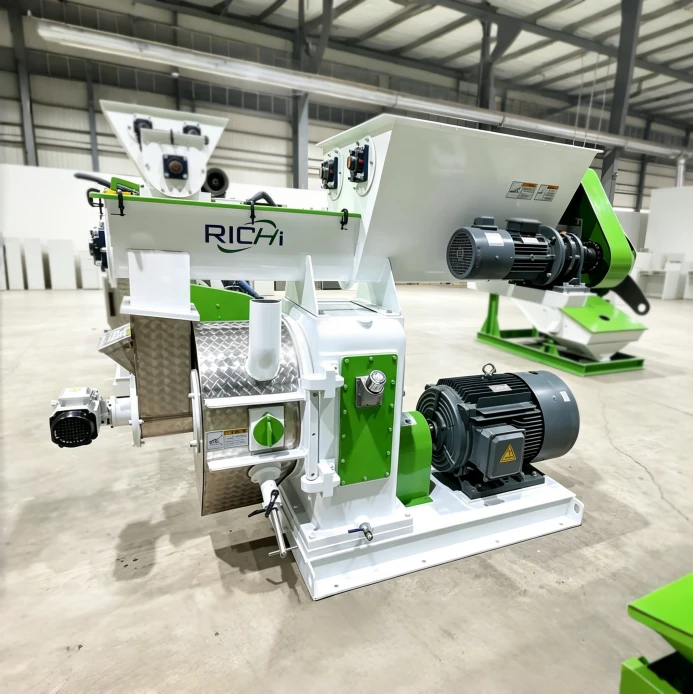
It is also worth considering the full line, not just the pellet mill. A cow dung pellet making machine for fertilizer is only one component. A complete line may include a compost turner, a grinder, a mixer, a dryer, a cooler, a screener, and a bagging machine. Skipping any of these steps can compromise pellet quality or make the operation uneconomical.
What Cow Dung Needs Before It Enters the Pellet Mill
Cow dung does not arrive at the pellet mill in a ready-to-press form. It arrives wet, biologically active, and inconsistent. The preprocessing steps are not optional extras. They are part of the production process.
Moisture Reduction
Fresh cow dung typically contains 75% to 85% moisture. Pelletizing requires moisture content below 20%, and most machines perform best in the 12% to 18% range. That means a significant amount of water must be removed before the material can be pressed into durable pellets.
Composting is the most common method for reducing moisture and stabilizing the material. A well-managed compost pile generates heat that drives off water and breaks down volatile compounds. It also reduces pathogen levels and weed seeds, which matters if the pellets will be used on food crops or sold as organic fertilizer.
Mechanical drying can speed up the process, but it adds capital cost and energy consumption. For small operations, passive or forced-aeration composting may be enough. For larger operations, a rotary dryer integrated into the line is often necessary to handle continuous production.
Particle Size and Consistency
Cow dung compost that has not been ground or screened can contain stones, fibrous clumps, and uneven particles. These cause inconsistent pellet formation, accelerated die wear, and frequent blockages. A hammer mill or similar grinding step is usually required to achieve a consistent particle size.
The goal is not to create powder, but to create a material with a narrow particle size distribution. Large particles create weak points in the pellet. Fine particles can clog the die. The ideal grind depends on the die design and the target pellet diameter, but consistency is more important than fineness.
Binders and Additives
Cow dung compost often pellets well on its own, especially if it contains some fibrous bedding material. But in some cases, a binder can improve pellet durability and reduce fines. Common binders include clay minerals, starch, or biochar. Biochar has the added benefit of incorporating carbon into the fertilizer product.
The decision to use a binder should be based on pellet quality requirements and market expectations. Many operations run without binders and still produce acceptable pellets. Adding a binder increases cost and complexity, so it should be justified by a specific need.
The Real Cost of Running a Cow Dung Pellet Line
The purchase price of the pellet mill is only one part of the total cost. A realistic budget must account for the entire production chain, from material handling to final packaging.
Capital cost. A complete cow dung pellet line can range from tens of thousands of dollars for a small, manually operated setup to several hundred thousand dollars for a high-capacity, automated facility. The pellet mill itself may represent only 20% to 40% of the total capital investment. Dryers, grinders, mixers, coolers, screeners, and bagging equipment add significantly to the total.
Energy cost. Pelletizing is energy-intensive. The pellet mill draws substantial power to compress material through the die. Drying, if mechanical, adds thermal energy. Conveying, cooling, and screening add electrical load. Energy cost per tonne varies with material moisture, pellet diameter, and machine efficiency. In regions with high electricity or fuel prices, energy can be the largest operating cost.
Labor. A pellet line is not unattended. It requires operators to feed material, monitor moisture, change dies, perform maintenance, and manage bagging. The labor requirement depends on the level of automation. A fully automated line may need one or two operators per shift. A manual line may need three or four.
Maintenance and wear parts. The die and rollers are consumables. Their lifespan depends on the abrasiveness of the material, moisture consistency, and operating practices. Cow dung compost that contains sand or grit will wear dies faster than clean compost. Budgeting for regular die replacement is part of normal operating cost, not an unexpected expense.
Feedstock cost. If the manure is already being handled as part of farm operations, the feedstock cost is essentially the cost of moving it to the pellet line. If manure must be purchased or transported from another farm, the economics change. Pelletizing only makes sense if the input material is available at low cost and the output product can be sold at a price that covers processing.
The break-even point is different for every farm. A farm that currently pays for manure hauling and spreading has a different starting point than a farm that spreads its own manure on its own land. A farm that can sell bagged organic fertilizer at a premium has a different revenue potential than a farm that uses pellets only for its own fields.
Pellet Quality and What It Means for Selling
If the pellets are used on the farm, quality requirements are less demanding. The pellets need to flow through a spreader and break down in the field. Durability and uniformity matter, but they do not need to meet retail standards.
If the pellets are sold, quality becomes a commercial issue. Buyers of organic fertilizer expect consistent pellet size, low moisture, and good durability. A bag of pellets that contains excessive fines or broken pieces looks unprofessional and may not spread evenly.
The key quality parameters are:
- Durability: Pellets should survive handling, bagging, and transport without excessive breakage.
- Uniformity: Pellet diameter and length should be consistent.
- Moisture: Pellets should be dry enough to prevent mold growth during storage, typically below 15%.
- Appearance: Color and surface texture should be uniform.
- Nutrient content: The nutrient profile should be documented and consistent.
These parameters are not achieved by the pellet mill alone. They are the result of the entire process, from feedstock selection to drying and cooling. A well-designed line with proper moisture control and grinding will produce better pellets than a poorly designed line with a high-end pellet mill.
Common Mistakes in Cow Dung Pellet Projects
Several mistakes appear again and again in farm-scale pellet projects. Avoiding them can save significant time and money.
Sizing the machine for peak production rather than average production. A machine that can handle the busiest week of the year will be underutilized for the rest of the year. It is often better to size for average production and use a stockpile or custom processing during peak periods.
Underestimating the importance of drying. Moisture is the single most common cause of pelletizing problems. If the material is too wet, the pellet mill will clog, the pellets will be weak, and the die will wear quickly. Drying is not a step that can be skipped or improvised.
Ignoring feedstock variability. Cow dung is not a uniform material. Its moisture, fiber content, and particle size vary with diet, bedding, storage, and season. A machine that works well with one batch may struggle with the next. Robust preprocessing and consistent blending help reduce variability.
Choosing a machine without considering maintenance. Pellet mills require regular maintenance. Dies wear out. Rollers need adjustment. Bearings need lubrication. If the farm does not have the technical staff or the spare parts supply to maintain the machine, downtime will increase and performance will decline.
Assuming that pellets will sell themselves. Producing a good pellet is only half the challenge. Finding buyers, meeting their quality expectations, and managing logistics are equally important. Before investing in a pellet line, it is worth researching the local market for organic fertilizer and understanding what price the product can command.
A Practical Decision Framework
For a farm or business considering a cow dung pellet project, the decision can be broken down into a sequence of practical steps.
Step 1: Quantify available feedstock. Determine how much cow dung is available for pelletizing on a daily, weekly, and seasonal basis. Account for existing uses and labor constraints.
Step 2: Define the product. Decide whether the pellets will be used on the farm, sold in bulk, or sold in bags. This determines the required quality and the necessary processing steps.
Step 3: Choose the process. Decide between composting, mechanical drying, or a combination. Determine whether grinding and mixing are needed. Select the pellet mill type and size based on feedstock and product requirements.
Step 4: Estimate the full cost. Calculate capital cost, energy cost, labor cost, maintenance cost, and feedstock cost. Compare the total cost per tonne with the expected value of the product.
Step 5: Plan for operation and maintenance. Identify who will run the line, how they will be trained, and how spare parts will be sourced. A pellet line is a production asset, not a piece of equipment that can be ignored between uses.
Step 6: Start at a manageable scale. It is usually better to start with a smaller line and expand later than to invest in a large line that cannot be fully utilized. A modest start allows the farm to learn the process, build market relationships, and refine operations before committing to a larger investment.
For buyers who want to see how different equipment options fit together—from pellet mills to complete organic fertilizer production lines—it can be helpful to review the range of solutions available from experienced manufacturers. Companies like Richi Machinery that serve multiple scales and material types often provide practical guidance on line configuration, not just machine specifications. For a broader view of organic fertilizer equipment and how individual machines integrate into a full production system, you can also review this resource: https://pelletmakermachine.com/organic-fertilizer-machine/.
The Bottom Line
A cow dung making machine is not a standalone solution. It is the center of a production system that includes material collection, preprocessing, pelletizing, cooling, screening, and packaging. The success of the project depends less on the machine itself and more on how well the entire system is matched to the farm’s actual material flow, labor availability, and market situation.
The farms that get it right tend to be the ones that start with a clear understanding of their feedstock, choose equipment that fits their realistic production scale, and commit to the preprocessing steps that make good pellets possible. They do not buy a machine because a neighbor did. They buy a system because they have a material problem to solve and a product to sell.
That is the difference between a pellet line that runs for a few weeks and one that becomes a permanent part of the farm’s operation.