



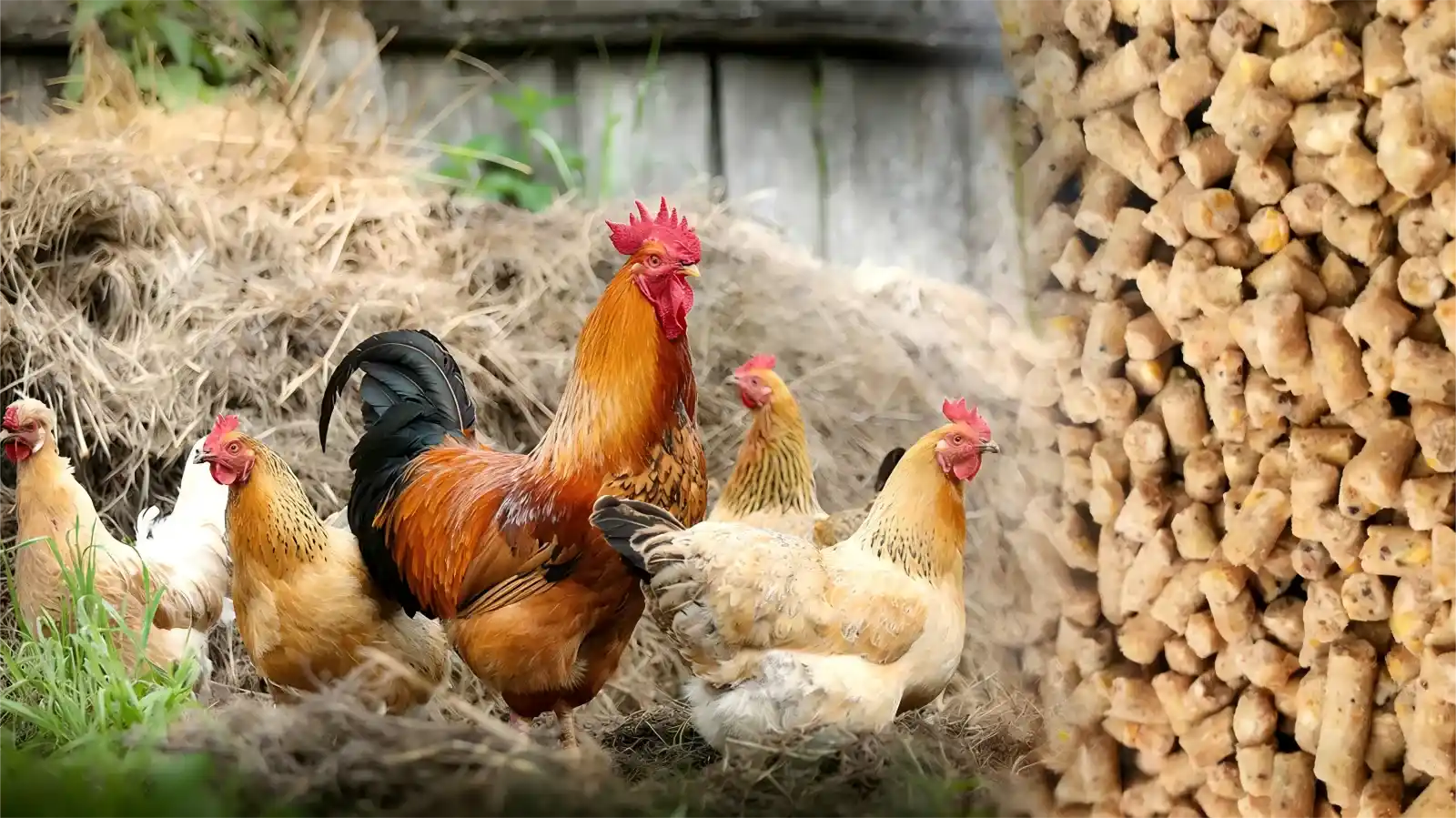
Chicken feed pellets are widely used in modern poultry farming because they provide a convenient and relatively uniform way to deliver nutrients to chickens. Compared with loose feed, properly manufactured pellets can reduce ingredient separation, simplify handling, improve feeding management, and make it easier to produce standardized feed for different poultry growth stages.
But how are chicken feed pellets actually made?
Modern chicken feed production involves much more than simply pressing a mixture of ingredients through a die. A complete pellet production process may include raw material receiving, cleaning, crushing, grinding, batching, mixing, steam conditioning, pelletizing, cooling, screening, crumbling, coating, conveying, and packaging.
The central equipment in this process is the pellet mill. However, the final pellet quality and production efficiency depend on how well the entire production system is designed and operated.
For poultry feed manufacturers researching chicken feed pellet mill for sale options, understanding the technology behind pellet production is essential. The right equipment configuration should match the feed formula, production capacity, pellet size, raw materials, automation requirements, and future expansion plans.
1. What Are Chicken Feed Pellets?
Chicken feed pellets are compressed feed products made by processing a mixture of nutritional ingredients through a pelletizing system.
Typical raw materials may include:
- Corn
- Wheat
- Barley
- Soybean meal
- Rice bran
- Wheat bran
- Rapeseed meal
- Sunflower meal
- Fish meal
- Vegetable protein sources
- Vegetable oil
- Molasses
- Vitamins
- Minerals
- Amino acids
- Other feed additives
The exact formula depends on the type and growth stage of the chickens.
For example, broiler starter feed is generally formulated differently from broiler finisher feed. Layer feed may also have different nutritional and physical requirements because laying hens need appropriate levels of calcium and other nutrients.
The purpose of pelletizing technology is to transform the prepared feed mixture into compact, uniform particles that can be handled, transported, stored, and consumed efficiently.
2. Why Is Technology Important in Chicken Feed Pellet Production?
The quality of chicken feed pellets depends on many processing parameters.
A poor production process may result in:
- Uneven pellet size
- Excessive fines
- Low pellet durability
- High moisture
- Poor nutrient distribution
- Unstable production
- High energy consumption
- Frequent equipment blockages
Modern feed pellet technology addresses these problems by controlling the material at every stage.
The main technologies involved include:
- Raw material cleaning
- Crushing and grinding
- Automatic batching
- Mixing
- Steam conditioning
- Mechanical pelletizing
- Pellet cooling
- Screening
- Crumbling when required
- Liquid coating
- Automated conveying and packaging
Each process contributes to the performance of the final product.
3. Raw Material Cleaning Technology
The first stage is usually raw material receiving and cleaning.
Agricultural materials can contain stones, metal, plastic, ropes, dust, and other foreign materials. If these impurities enter the grinding or pelletizing system, they can damage equipment or reduce production efficiency.
Cleaning equipment may include:
- Vibrating screens
- Rotary screens
- Magnetic separators
- Pre-cleaning systems
- Dust collection equipment
Magnetic separators are particularly useful for removing ferrous metal particles.
Effective cleaning protects downstream equipment and helps maintain stable operation.
It also reduces the risk of contamination in the finished chicken feed.
4. Crushing and Grinding Technology
Grinding is one of the most important preparation processes.
Most grains need to be reduced to a suitable particle size before mixing and pelletizing. Hammer mills are commonly used for grinding corn, wheat, and other feed ingredients.
The objective is not simply to produce the smallest possible particles.
The particle size should be suitable for:
- Chicken age
- Feed formula
- Pellet diameter
- Pellet durability
- Production capacity
- Energy consumption
If particles are too coarse, the material may not mix or pelletize uniformly.
If particles are excessively fine, grinding energy consumption can increase and dust generation may become a problem.
Therefore, grinding technology must balance particle size with production economics.
5. Automatic Batching Technology
After grinding, different ingredients need to be combined according to the feed formula.
Modern feed mills often use automatic batching systems.
A batching system normally consists of ingredient bins, weighing equipment, gates, feeders, and a control system.
Major ingredients such as corn and soybean meal can be weighed automatically according to the programmed formula.
Small quantities of additives can also be measured accurately with specialized dosing equipment.
Automatic batching provides several benefits:
- Higher weighing accuracy
- More consistent formulas
- Reduced manual labor
- Faster formula changes
- Better production records
- Improved traceability
Accurate batching is particularly important because nutritional consistency depends on the correct proportion of each ingredient.
6. Feed Mixing Technology
After batching, ingredients need to be mixed uniformly.
A feed mixer combines different materials into a homogeneous mixture before pelletizing.
Common mixer types include horizontal single-shaft mixers, double-shaft mixers, and other industrial mixing systems.
Mixing efficiency depends on:
- Ingredient particle size
- Batch size
- Mixing time
- Mixer design
- Ingredient sequence
- Liquid addition
- Loading ratio
The goal is to distribute proteins, grains, minerals, vitamins, and additives throughout the feed mixture.
Poor mixing may cause nutritional variation between pellets.
An efficient mixer can improve product consistency while reducing the time required for each batch.
7. Steam Conditioning Technology
Steam conditioning is a key technology used in modern chicken feed pellet production.
Before entering the pellet mill, the feed mixture can pass through a conditioner where steam is introduced.
The combination of heat and moisture changes the physical characteristics of the feed material.
Proper conditioning can:
- Improve pellet formation
- Increase pellet durability
- Reduce fines
- Improve pellet mill throughput
- Reduce mechanical stress
- Improve starch gelatinization
- Improve material binding
The conditioning process needs to be controlled carefully.
Important factors include:
- Steam pressure
- Steam quality
- Moisture level
- Conditioning time
- Feed formula
- Material flow
- Temperature
Different feed formulas may require different conditioning parameters.
8. The Role of the Chicken Feed Pellet Mill
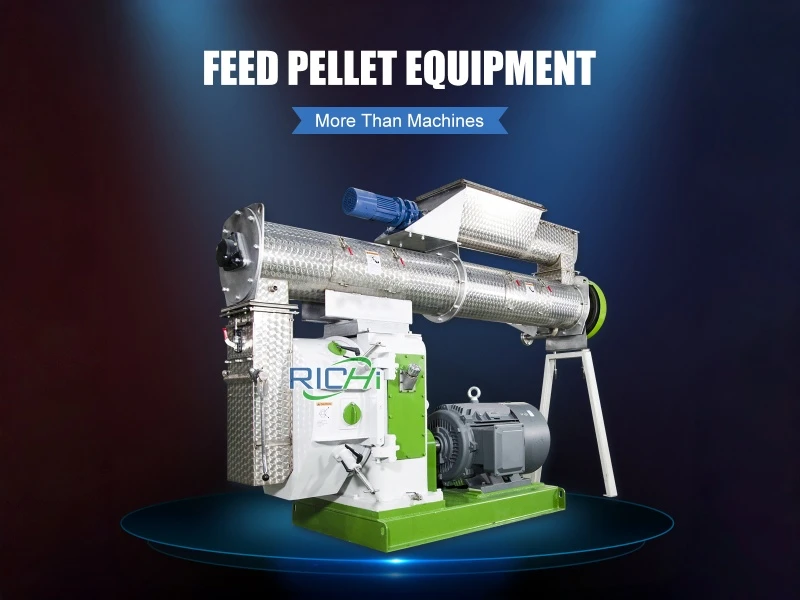
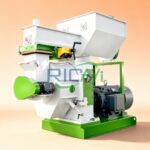
The pellet mill is the core machine used to convert conditioned feed into pellets.
In a typical ring die pellet mill, conditioned feed enters the pelletizing chamber. Rotating rollers press the material through holes in the ring die.
As the compressed material passes through the die holes, it forms continuous strands that are cut into pellets by knives.
The basic process can be represented as:
Conditioned Feed → Compression → Die Extrusion → Cutting → Chicken Feed Pellets
The pellet mill must provide sufficient compression while maintaining stable material flow.
A properly configured machine can produce consistent pellets at the required capacity.
(Learn more: https://richipelletizer.com/chicken-feed-pellet-machine-for-sale/)
9. Ring Die Pelletizing Technology
Ring die pellet mills are widely used for commercial feed production because they can provide relatively high throughput and continuous operation.
A ring die contains multiple holes that determine the pellet diameter.
The die design can be selected according to the desired chicken feed specification.
Important factors include:
- Die hole diameter
- Die thickness
- Compression ratio
- Material characteristics
- Pellet diameter
- Production capacity
Different chicken feed products may require different pellet sizes.
For example, younger chickens generally require smaller particles, while larger broilers may consume larger pellets.
The correct die configuration helps achieve stable pellet formation.
10. Pellet Diameter and Die Selection
Pellet diameter is an important part of chicken feed production technology.
The appropriate size depends on chicken age, feeding system, feed formula, and customer requirements.
Typical production may involve different sizes for:
- Chicks
- Broiler starter
- Broiler grower
- Broiler finisher
- Layers
- Breeders
When selecting a pellet mill, manufacturers should consider whether the machine can accommodate the required die specifications.
A production line that needs to manufacture multiple pellet sizes may require interchangeable dies or multiple pelletizing configurations.
11. Compression Ratio Technology
The compression ratio of the die affects how easily feed material forms pellets.
Different raw materials have different pelletizing characteristics.
Corn-based formulas may behave differently from formulas containing higher levels of fiber, bran, or other ingredients.
If the compression ratio is unsuitable, the production line may experience:
- Low throughput
- Excessive fines
- High energy consumption
- Poor pellet durability
- Unstable pellet formation
Therefore, die selection should be based on both pellet diameter and feed formula.
This is one reason buyers should evaluate the complete processing requirements when looking for a chicken feed pellet mill for sale.
12. Roller Technology
The rollers work together with the ring die to compress the feed material.
Roller surface condition and adjustment have a direct impact on pellet production.
Important roller considerations include:
- Wear resistance
- Roller surface design
- Bearing quality
- Roller clearance
- Lubrication
- Maintenance requirements
As the rollers wear, the pellet mill may gradually lose production efficiency.
Regular inspection and appropriate adjustment can help maintain stable pellet production.
13. Cooling Technology
Fresh pellets leaving the pellet mill are hot and contain additional moisture from conditioning.
They cannot normally be packaged immediately.
Cooling is therefore an essential process.
A counterflow cooler is commonly used in larger production systems.
The cooler reduces pellet temperature and moisture while helping stabilize the pellet structure.
Effective cooling can improve:
- Pellet durability
- Storage stability
- Packaging efficiency
- Product appearance
- Production continuity
Insufficient cooling may result in condensation inside bags or storage systems.
Therefore, cooling capacity should be properly matched with pellet mill output.
14. Screening Technology
After cooling, the pellets are normally screened.
Screening removes:
- Fines
- Broken pellets
- Oversized particles
- Other unwanted material
Qualified pellets continue to packaging, while fines can often be recycled into the production process.
A good screening system helps improve product uniformity.
However, excessive fines may indicate that the upstream pelletizing process needs improvement.
Possible causes include poor conditioning, inappropriate die configuration, worn rollers, excessive mechanical handling, or insufficient cooling.
15. Crumbling Technology for Young Chickens
Some chicken feed products are not supplied as full-size pellets.
For young chickens, pellets may need to be reduced into smaller particles called crumbles.
The typical process is:
Pelletizing → Cooling → Crumbling → Screening → Packaging
A feed crumbler uses specially designed rollers to break pellets into smaller particles.
The final crumble size can be adjusted according to the requirements of the feed product.
A production line that supplies different chicken growth stages may therefore combine pelletizing and crumbling equipment.
16. Liquid Addition and Coating Technology
Some feed formulas require the addition of oil, molasses, or other liquid ingredients.
Liquid addition technology must distribute the material evenly.
If liquids are added poorly, they can create:
- Uneven moisture
- Sticky material
- Poor mixing
- Pellet mill blockages
- Uneven pellet quality
Liquid addition systems may use pumps, pipelines, spraying devices, flow meters, and automated controls.
For some products, post-pellet coating can also be used to add oil or other liquid nutrients after cooling.
This allows manufacturers to improve the nutritional or physical characteristics of the finished feed without placing excessive liquid load on the pellet mill.
17. Automation Technology
Automation has become increasingly important in modern chicken feed production.
A centralized control system can connect different processing stages.
The system may monitor:
- Raw material levels
- Batching weights
- Mixer status
- Pellet mill motor load
- Steam conditions
- Cooler operation
- Conveyor status
- Packaging equipment
- Equipment alarms
Automation can reduce manual intervention and improve production consistency.
For large feed mills, automatic formula management can also make it easier to switch between different chicken feed products.
18. Sensors and Real-Time Monitoring
Sensors provide important operating information.
For example, current sensors can monitor motor load, temperature sensors can monitor equipment conditions, and weighing systems can monitor material quantities.
Real-time data can help operators identify problems such as:
- Overloading
- Material blockage
- Abnormal temperature
- Insufficient material flow
- Unstable batching
- Equipment failure
This allows corrective action to be taken earlier.
Modern feed plants can therefore combine mechanical equipment with digital monitoring to improve production efficiency.
19. Energy Efficiency in Chicken Feed Pellet Production
Energy consumption is an important operating cost.
Major energy-consuming equipment may include:
- Hammer mills
- Pellet mills
- Fans
- Conveyors
- Coolers
- Compressors
- Packaging systems
Grinding and pelletizing normally account for a significant share of electrical consumption.
Energy efficiency can be improved through:
- Appropriate particle size
- Efficient motors
- Stable feeding
- Proper die selection
- Effective conditioning
- Preventive maintenance
- Variable-frequency drives
- Reduced material transfer
- Balanced equipment capacity
A machine that produces high output but consumes excessive energy per ton may not provide the best overall operating economics.
20. Technology for Reducing Pellet Fines
Pellet fines can reduce effective production output and increase material handling requirements.
Several technologies can help reduce fines.
These include:
Better Conditioning
Adequate steam conditioning improves binding and pellet formation.
Correct Die Selection
The compression ratio should match the feed formula.
Proper Cooling
Rapid and controlled cooling helps stabilize the pellet structure.
Gentle Conveying
Excessive impact during transportation can break pellets.
Effective Screening
A suitable screen separates fines without excessive mechanical damage.
Reducing fines throughout the process can increase the percentage of finished product that can be sold directly.
21. Technology for Different Chicken Feed Formulas
Modern pelletizing technology needs to accommodate different formulas.
Broiler Feed
Broiler feed often emphasizes energy and protein requirements and may be produced in different pellet sizes for different growth stages.
Layer Feed
Layer feed may contain higher levels of calcium and other nutrients needed for egg production.
Chick Feed
Young chicken feed often requires smaller particle sizes or crumbles.
Breeder Feed
Breeder feed may require specific nutritional formulations and carefully controlled pellet specifications.
A flexible production line should allow manufacturers to adjust the formula, pellet size, and process parameters according to the final product.
22. How to Choose a Chicken Feed Pellet Mill for Sale
When looking for a chicken feed pellet mill for sale, buyers should evaluate more than the machine price.
Important factors include:
Production Capacity
Determine the required tons per hour based on current demand and future expansion.
Feed Formula
Tell the supplier what raw materials will be used.
Pellet Size
Confirm the required pellet diameters.
Die Configuration
Ask whether the machine can use suitable dies for different products.
Power Consumption
Compare energy consumption relative to actual output.
Wear Parts
Check the availability and expected service life of dies, rollers, bearings, and other wearing components.
Automation
Determine whether manual, semi-automatic, or fully automated control is appropriate.
Maintenance
Evaluate how easy it is to inspect and replace critical components.
Complete Line Compatibility
The pellet mill should be matched with the grinder, mixer, conditioner, cooler, screen, crumbler, conveyors, and packaging system.
23. Individual Pellet Mill or Complete Production Line?
Some customers only need a pellet mill, while others require a complete chicken feed production plant.
An individual machine may be suitable when:
- The feed mixture is already prepared.
- Production capacity is relatively small.
- Existing auxiliary equipment is available.
- The customer wants to upgrade only the pelletizing stage.
A complete production line may be more suitable when:
- The customer is building a new feed mill.
- Multiple raw materials need to be processed.
- Automatic batching is required.
- Commercial-scale production is planned.
- Cooling and screening need to be integrated.
- Packaging automation is required.
The decision should be based on the actual production process rather than the equipment price alone.
24. Why Production Line Integration Matters
A pellet mill cannot achieve its rated capacity if the upstream or downstream equipment is undersized.
For example, a high-capacity pellet mill may have to wait for the mixer if the mixing system cannot supply enough conditioned feed.
Similarly, if the cooler or screening system cannot process the pellet mill’s output, the entire line may need to slow down.
Therefore, modern chicken feed production technology focuses on system integration.
A balanced production line should coordinate:
Cleaning → Grinding → Batching → Mixing → Conditioning → Pelletizing → Cooling → Screening → Crumbling → Packaging
Not every plant needs every process, but the selected equipment should work together as one system.
(click to investigate:RICHI Pelletizer )
25. Preventive Maintenance Technology
Regular maintenance is essential for maintaining pellet production efficiency.
A maintenance program should cover:
- Pellet mill
- Ring die
- Rollers
- Bearings
- Gearbox
- Hammer mill
- Mixer
- Cooler
- Conveyors
- Electrical system
- Dust collection system
Operators should monitor abnormal noise, vibration, temperature, current, and material flow.
Worn components should be replaced before they cause major failures.
Preventive maintenance reduces unplanned downtime and helps extend equipment service life.
26. Factory Layout and Material Flow
Factory layout also affects production efficiency.
An efficient layout should provide:
- Short material transfer routes
- Logical process sequence
- Adequate maintenance space
- Safe operator access
- Convenient raw material storage
- Suitable finished-product storage
- Effective dust collection
- Proper ventilation
Unnecessary conveying and repeated material handling can increase energy consumption and create additional opportunities for pellet breakage.
A professional production line design should consider the building structure, raw material flow, equipment dimensions, electrical system, storage capacity, and future expansion.
27. Turnkey Chicken Feed Pellet Production Technology
For commercial poultry feed projects, a turnkey solution can integrate all major processing stages.
A complete system may include:
- Raw material receiving system
- Cleaning equipment
- Hammer mill
- Automatic batching system
- Feed mixer
- Steam conditioner
- Chicken feed pellet mill
- Counterflow cooler
- Vibrating screen
- Feed crumbler
- Conveying system
- Packing machine
- Dust collection system
- Electrical control system
The exact configuration depends on production capacity, feed formulas, pellet specifications, factory layout, and automation requirements.
A customized engineering approach can help ensure that each machine is correctly matched to the others.
(Learn about turnkey poultry feed manufacturing plant cost )
28. Future Trends in Chicken Feed Pellet Technology
Chicken feed production technology is moving toward higher automation, better process control, improved energy efficiency, and greater flexibility.
Future feed mills are likely to place greater emphasis on:
- Automatic formula management
- Real-time production monitoring
- Intelligent equipment control
- Energy monitoring
- Predictive maintenance
- Automated packaging
- Digital production records
- Flexible multi-formula production
The goal is not simply to increase machine speed but to improve the overall efficiency and consistency of the production system.
29. Conclusion
The technology used to make chicken feed pellets includes much more than mechanical pelletizing.
A modern production process can involve raw material cleaning, grinding, automatic batching, mixing, steam conditioning, ring die pelletizing, cooling, screening, crumbling, liquid addition, conveying, packaging, and automated control.
The pellet mill remains the core piece of equipment, but its performance depends heavily on the processes before and after it.
For manufacturers researching a chicken feed pellet mill for sale, the most important considerations include production capacity, feed formula, pellet diameter, die compression ratio, roller design, energy consumption, automation, maintenance requirements, and compatibility with the complete production line.
A properly designed chicken feed pellet production system can help manufacturers achieve stable pellet quality, efficient material processing, lower production losses, and reliable long-term operation.
Whether the project is a small poultry feed operation or a large commercial feed mill, equipment selection should begin with the complete production requirement. By matching the grinding, batching, mixing, conditioning, pelletizing, cooling, screening, and packaging processes, manufacturers can build a more efficient and flexible chicken feed pellet production system.