



Nutrition is one of the most important factors affecting poultry growth, feed utilization, egg production, flock health, and overall farm performance. A well-formulated chicken feed provides the required balance of energy, protein, amino acids, minerals, vitamins, and other nutrients. However, a good formula alone does not guarantee that every chicken will receive a consistent and properly processed ration.
Feed processing technology plays an important role in converting a nutritional formula into a practical feed product. Among different feed forms, pellets are widely used because they can provide a relatively uniform combination of ingredients and make the feed easier to handle, transport, store, and distribute.
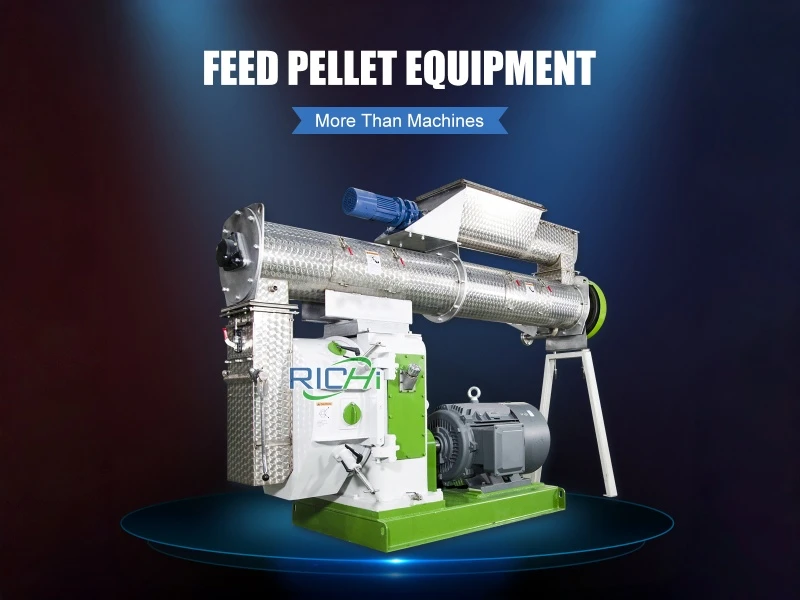
Modern chicken feed pellet technology combines raw material preparation, grinding, batching, mixing, conditioning, pelletizing, cooling, screening, and other processes. The chicken feed pellet making machine is one of the core pieces of equipment in this system, but its performance depends on the quality of the entire production process.
By controlling particle size, ingredient distribution, moisture, conditioning, pellet density, durability, and finished-product quality, pellet production technology can help manufacturers deliver more consistent nutrition to poultry.
1. Why Feed Processing Matters for Chicken Nutrition
Chicken feed contains many different ingredients.
A typical formula may include:
- Corn
- Wheat
- Barley
- Soybean meal
- Rice bran
- Wheat bran
- Vegetable protein sources
- Vegetable oil
- Fish meal
- Minerals
- Vitamins
- Amino acids
- Feed additives
Each ingredient contributes different nutrients.
Corn may provide energy, soybean meal is commonly used as a protein source, while mineral and vitamin premixes provide smaller but important quantities of essential nutrients.
The challenge is ensuring that these ingredients are distributed consistently throughout the final feed.
If feed is not mixed properly, nutrient concentrations may vary from one portion to another.
Pellet technology helps transform a thoroughly mixed feed formula into compact particles, reducing the tendency of ingredients to separate during handling and transportation.
2. Uniform Nutrient Distribution
One of the major nutritional advantages of properly manufactured pellets is improved uniformity.
Before pelletizing, the ingredients are ground, accurately weighed, and mixed.
The mixture is then compressed into pellets.
Because multiple ingredients become physically combined within the pellet, the risk of ingredient separation during subsequent handling can be reduced.
This is especially useful when the formula contains:
- Fine particles
- Mineral premixes
- Vitamins
- Amino acids
- Protein meals
- Small quantities of additives
Without adequate processing, smaller particles may settle differently from larger particles during transportation or storage.
Pelletizing helps maintain a more consistent physical feed structure.
3. Accurate Feed Formulation Comes First
Pellet technology cannot compensate for a poorly designed feed formula.
The nutritional process should begin with accurate formulation based on the nutritional requirements of the target poultry group.
Different chickens have different nutritional needs.
For example:
- Broiler starter feed
- Broiler grower feed
- Broiler finisher feed
- Layer feed
- Chick feed
- Breeder feed
These feeds may differ in energy, protein, amino acids, calcium, phosphorus, fiber, and other nutritional parameters.
The production system must therefore be able to process different formulas while maintaining accurate ingredient ratios.
Automatic batching systems can improve formulation accuracy by weighing ingredients according to programmed recipes.
4. Grinding Technology and Nutrient Utilization
Grinding is an important preparation step in chicken feed production.
Grain ingredients such as corn and wheat are commonly ground before mixing and pelletizing.
Appropriate particle size can improve the physical uniformity of the feed and support more consistent pellet formation.
However, smaller particles are not automatically better.
Excessive grinding can increase energy consumption and dust generation, while overly coarse particles may reduce mixing uniformity and affect pellet quality.
The appropriate particle size should be determined according to:
- Chicken age
- Feed formula
- Pellet size
- Raw material characteristics
- Pellet mill configuration
- Production capacity
A properly designed grinding process creates a suitable foundation for later mixing and pelletizing.
5. Better Mixing Supports Nutritional Consistency
After grinding and batching, ingredients must be mixed thoroughly.
The purpose of mixing is to distribute all ingredients throughout the feed mass.
This is particularly important for ingredients used in relatively small quantities.
For example, vitamin and mineral premixes may represent only a small percentage of the total formula, but they need to be distributed consistently.
An efficient feed mixer can help ensure that each batch has a similar nutrient composition.
Mixing performance depends on:
- Mixer design
- Mixing time
- Ingredient particle size
- Batch size
- Loading ratio
- Ingredient sequence
- Liquid addition
If mixing is inadequate, pelletizing alone cannot guarantee uniform nutritional distribution.
6. How Pelletizing Helps Reduce Ingredient Separation
Feed ingredients have different particle sizes, densities, and physical characteristics.
For example, grains, soybean meal, bran, minerals, and additives may behave differently during transportation.
This can result in segregation.
Pelletizing changes the physical form of the mixture by compressing the ingredients together.
Instead of transporting a loose mixture of different particles, the feed mill produces compact pellets with a relatively consistent composition.
This can help reduce separation during:
- Conveying
- Storage
- Bagging
- Transportation
- Feed distribution
For poultry farms, this means chickens are less likely to selectively consume certain components of the feed.
7. The Role of Steam Conditioning
Steam conditioning is one of the most important technologies used before pelletizing.
The mixed feed enters a conditioner where steam is introduced.
The steam provides heat and moisture, which changes the physical properties of the feed material.
Proper conditioning can improve pellet formation and durability.
It may also contribute to changes in starch structure and improve the overall processing characteristics of the feed.
Important conditioning parameters include:
- Steam quality
- Steam pressure
- Temperature
- Moisture
- Conditioning time
- Feed flow rate
- Feed formula
Different formulas may require different conditioning conditions.
A formula containing more fiber, for example, may behave differently from a grain-rich formula.
8. Starch Changes During Conditioning
Many chicken feed formulas contain significant quantities of cereal grains.
These grains contain starch.
When exposed to heat and moisture during conditioning, starch undergoes physical changes that can improve its processing characteristics.
The degree of starch gelatinization depends on factors such as:
- Temperature
- Moisture
- Time
- Raw material type
- Particle size
The purpose of conditioning is not simply to heat the feed.
It is to create suitable physical conditions for efficient pellet formation while maintaining appropriate feed quality.
Properly controlled conditioning can also reduce the mechanical load required during pelletizing.
9. The Role of the Chicken Feed Pellet Making Machine
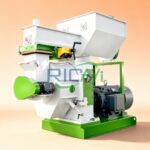
The chicken feed pellet making machine converts conditioned feed into compact pellets.
In a typical ring die pellet mill, the conditioned material enters the pelletizing chamber.
Rotating rollers compress the material against the ring die.
The material is forced through die holes and then cut into pellets of the desired length.
The basic process is:
Mixed Feed → Steam Conditioning → Compression → Extrusion → Cutting → Pellets
The machine must maintain stable pressure and material flow to produce consistent pellets.
A properly selected pellet mill can help manufacturers control:
- Pellet diameter
- Pellet density
- Pellet shape
- Pellet durability
- Production capacity
(Learn more:https://richipelletizer.com/chicken-feed-pellet-machine-for-sale/)
10. Pellet Size and Poultry Nutrition
Pellet size matters because chickens of different ages have different feeding abilities.
Chicks generally require smaller feed particles than mature broilers.
As chickens grow, the physical size of the feed can be adjusted.
Feed manufacturers may produce:
- Starter crumble
- Starter pellets
- Grower pellets
- Finisher pellets
- Layer feed pellets
The correct pellet size can make the feed easier for chickens to consume.
It can also support consistent feed intake across the flock.
A flexible chicken feed pellet making machine can be configured with different dies to produce different pellet diameters.
11. Pellet Density and Feed Intake
Pellet density affects how much feed material is contained within a given volume.
If pellets are too light and fragile, chickens may encounter more fines.
If pellets are excessively dense or physically unsuitable, they may not provide the desired feeding characteristics.
The objective is to produce pellets with an appropriate structure and durability for the target poultry group.
Pellet density can be influenced by:
- Feed formula
- Moisture
- Steam conditioning
- Die compression ratio
- Roller adjustment
- Pellet mill operating conditions
These parameters should be optimized together rather than individually.
12. Pellet Durability and Nutrient Delivery
Pellet durability is important because pellets are exposed to mechanical forces after leaving the pellet mill.
They may pass through:
- Coolers
- Screens
- Conveyors
- Storage bins
- Packaging machines
- Trucks
- Feeders
If pellets break easily, the amount of fines increases.
Fines can create several problems.
They may separate from larger pellets during handling, create additional dust, and make feed distribution less uniform.
Producing durable pellets helps maintain the physical integrity of the feed until it reaches the poultry.
13. Cooling Protects Finished Feed Quality
Pellets leaving the pellet mill are hot and contain moisture.
They need to be cooled before storage and packaging.
A counterflow cooler is commonly used for commercial production.
The cooling process reduces:
- Pellet temperature
- Moisture
- Condensation risk
Proper cooling helps stabilize the pellets.
If pellets are packaged while they are still too hot or wet, condensation can develop inside the packaging.
This can negatively affect storage stability.
Therefore, cooling technology is directly connected with finished feed quality.
14. Screening Removes Excessive Fines
After cooling, pellets are screened.
The purpose is to separate qualified pellets from fines and unwanted particles.
An effective screening system helps maintain consistent product quality.
However, excessive fines should not simply be considered a screening problem.
They may indicate upstream issues such as:
- Poor conditioning
- Incorrect die compression
- Excessive moisture
- Insufficient cooling
- Worn rollers
- Poor pellet mill operation
- Excessive mechanical handling
Reducing fines at their source is more effective than relying entirely on recycling.
15. Crumbling Technology for Young Chickens
Young chickens may require smaller feed particles.
Instead of directly producing extremely small pellets, some manufacturers produce pellets first and then use a crumbler.
The process can be:
Pelletizing → Cooling → Crumbling → Screening
A crumbler uses rollers to break pellets into smaller particles.
The resulting crumbles are easier for young birds to consume.
This technology allows one production line to serve different poultry growth stages.
16. Supporting Broiler Nutrition
Broiler production requires carefully formulated feed at different stages.
A typical feeding program may include starter, grower, and finisher feeds.
Each stage has different nutritional requirements.
Pellet technology supports this system by allowing manufacturers to produce different formulas and pellet sizes.
For example, starter feed may use smaller particles, while finisher feed may use larger pellets.
The ability to change formulas and die specifications provides feed manufacturers with greater flexibility.
17. Supporting Layer Feed Production
Layer chickens require feed designed to support egg production and maintain appropriate body condition.
Layer feed may contain different levels of calcium and other minerals compared with broiler feed.
The production process must ensure that these nutrients are distributed evenly.
Proper batching and mixing are especially important for mineral ingredients.
Pelletizing then helps convert the homogeneous mixture into a stable physical form.
18. Reducing Selective Feeding
Chickens may selectively consume certain feed particles if the feed is presented as a loose mixture.
This can potentially lead to uneven intake of certain ingredients.
Pellets reduce the physical differences between ingredients by compressing them together.
Each pellet contains a combination of the ingredients used in the formula.
This helps make the feed more consistent from the physical feeding perspective.
It is particularly useful when the formula contains fine particles and small-dose additives.
19. Improving Feed Handling
Nutrition is not only about the chemical composition of feed.
The physical properties of feed also influence how efficiently it can be handled.
Pellets are generally easier to:
- Transport
- Store
- Load
- Unload
- Package
- Distribute
A more stable physical product can reduce material losses during handling.
Less breakage means fewer fines and less variation between the feed entering the storage system and the feed eventually delivered to poultry.
20. Moisture Control and Nutritional Stability
Moisture management is essential throughout pellet production.
The production process introduces moisture during steam conditioning, while cooling removes heat and part of the added moisture.
The final moisture level should be suitable for safe storage and handling.
Too much moisture can increase storage risks, while excessive drying can affect production efficiency and energy consumption.
Moisture should therefore be monitored at different stages rather than treated as a single final-product parameter.
21. Oil and Liquid Ingredient Technology
Modern chicken feed formulas may contain vegetable oil, molasses, or other liquid ingredients.
These ingredients need to be distributed evenly.
Liquid addition systems can use pumps and spraying devices to introduce liquids into the mixer or conditioning system.
For some formulas, post-pellet coating may also be used.
This allows certain liquid nutrients or energy sources to be added after pellet formation.
The appropriate method depends on the formula and production requirements.
22. Automation Improves Feed Consistency
Automation can contribute to nutritional consistency by reducing human error.
A centralized control system can manage:
- Ingredient batching
- Mixing
- Steam conditioning
- Pellet mill feeding
- Cooling
- Screening
- Packaging
Automatic formula management can ensure that the correct ingredient quantities are used for each production batch.
Sensors can also monitor process conditions in real time.
For commercial feed manufacturers, this helps create more repeatable production results.
23. Process Control and Feed Quality
The nutritional value of a formula can be compromised if processing conditions are poorly controlled.
For example, excessive heat may affect certain heat-sensitive components, while inadequate conditioning may result in poor pellet quality.
Therefore, modern feed production seeks to balance nutritional preservation with effective processing.
Important control points include:
- Raw material quality
- Grinding
- Batching
- Mixing
- Conditioning
- Pelletizing
- Cooling
- Storage
A complete quality control program should monitor both nutritional and physical properties.
24. How Equipment Selection Affects Nutrition
Equipment selection should be based on the feed formula and production requirements.
A pellet mill that is suitable for one formula may not perform identically with another formula.
Factors to consider include:
- Raw material composition
- Fiber content
- Oil content
- Pellet diameter
- Required output
- Conditioning requirements
- Automation level
- Expected operating hours
The chicken feed pellet making machine should be integrated with upstream and downstream equipment.
A high-capacity pellet mill cannot deliver its full potential if the grinder, mixer, conditioner, cooler, or screening system is undersized.
25. Maintaining the Pellet Mill
Regular maintenance helps maintain stable pellet quality.
Important components include:
- Ring die
- Rollers
- Bearings
- Main shaft
- Gearbox
- Drive motor
- Feeding system
- Conditioner
Wear of the die and rollers can gradually affect pellet formation.
Possible signs include:
- Lower production capacity
- Increased fines
- Higher energy consumption
- Irregular pellet shape
- Unstable machine load
Regular inspection allows worn parts to be repaired or replaced before they significantly affect production.
26. Energy Efficiency and Nutritional Quality
Energy efficiency and feed quality should be considered together.
Excessive grinding, unstable pellet mill operation, poor conditioning, and unnecessary material handling can increase energy consumption.
An efficient production system should aim for:
- Stable throughput
- Appropriate particle size
- Efficient conditioning
- Correct die selection
- Proper roller adjustment
- Effective cooling
- Reduced fines
- Minimal material loss
Reducing energy consumption while maintaining consistent feed quality can improve the overall economics of pellet production.
27. Quality Control of Finished Pellets
Finished chicken feed pellets should be checked regularly.
Important quality parameters may include:
- Pellet size
- Pellet durability
- Moisture
- Bulk density
- Fines percentage
- Physical appearance
- Nutritional composition
Laboratory analysis may also be used to verify protein, moisture, minerals, and other nutritional parameters.
The production line should combine laboratory quality control with process monitoring.
28. Designing a Complete Chicken Feed Pellet Production Line
A complete chicken feed pellet production line may include:
Raw Material Receiving → Cleaning → Grinding → Batching → Mixing → Conditioning → Pelletizing → Cooling → Screening → Crumbling → Packaging
Not every project requires every stage.
For example, a feed mill producing only larger broiler pellets may not need a crumbler.
A plant producing starter, grower, finisher, and layer feeds may require more flexible processing equipment.
The production line should therefore be customized according to the customer’s product range.
(Learn about industrial poultry feed manufacturing plant cost)
29. Why Turnkey Engineering Can Improve Nutritional Consistency
A turnkey engineering approach allows the entire process to be designed as one system.
The supplier can consider:
- Raw materials
- Feed formulas
- Production capacity
- Pellet sizes
- Factory layout
- Automation
- Cooling requirements
- Packaging
- Storage
- Future expansion
This reduces the risk of selecting machines independently without considering their compatibility.
A well-integrated system can provide more stable material flow and more consistent processing conditions.
30. Practical Ways to Improve Nutritional Performance
Feed manufacturers can improve the nutritional consistency of chicken pellets by focusing on several practical areas.
Use Consistent Raw Materials
Stable raw material quality provides a reliable foundation for the formula.
Improve Grinding
Use appropriate particle sizes for the feed formula and poultry age.
Increase Batching Accuracy
Automatic weighing systems help maintain formula consistency.
Improve Mixing
Ensure that all ingredients are uniformly distributed.
Optimize Conditioning
Control temperature, moisture, steam, and conditioning time.
Select the Correct Pellet Mill
Match the machine and die configuration with the feed formula and capacity.
Maintain Pellet Durability
Inspect dies, rollers, conditioning, and cooling systems.
Control Finished Feed Moisture
Cool pellets properly before packaging.
Reduce Fines
Identify and correct upstream causes instead of simply recycling fines.
(click for more:RICHI Pelletizer)
31. The Relationship Between Pellet Technology and Feed Efficiency
Feed processing technology does not replace good nutrition management.
Instead, it provides a physical and processing system that helps deliver the formulated nutrients consistently.
A well-designed pellet production system can support:
- Uniform feed composition
- Consistent particle size
- Reduced ingredient separation
- Better handling
- Lower feed losses
- Stable pellet quality
- Efficient storage and transportation
The nutritional value of the finished product still depends on the quality and formulation of its ingredients.
Therefore, pellet technology should be viewed as an important part of a broader feed manufacturing and quality-control system.
32. Conclusion
Chicken feed pellet technology plays an important role in transforming a carefully designed nutritional formula into a stable and practical poultry feed product.
The process starts with quality raw materials and accurate formulation. Grinding, batching, and mixing then help create a uniform feed mixture. Steam conditioning prepares the material for efficient compression, while the chicken feed pellet making machine forms the mixture into consistent pellets.
After pelletizing, cooling and screening help stabilize the finished product and reduce excessive fines. Crumbling technology can further adapt pellets for young chickens, while liquid addition and coating systems provide flexibility for specialized formulas.
For poultry feed manufacturers, the objective is not simply to produce pellets. The goal is to produce pellets that consistently deliver the intended nutritional formula in a physical form that can be handled, stored, transported, and consumed efficiently.
Therefore, when designing or upgrading a chicken feed production line, manufacturers should evaluate the entire process rather than focusing on the pellet mill alone. Proper grinding, accurate batching, uniform mixing, controlled conditioning, suitable pelletizing, efficient cooling, and effective quality control all contribute to better nutritional consistency.
A properly configured chicken feed pellet making machine, combined with well-matched auxiliary equipment and appropriate process control, can help feed manufacturers produce more uniform and reliable poultry feed for different chicken growth stages.