


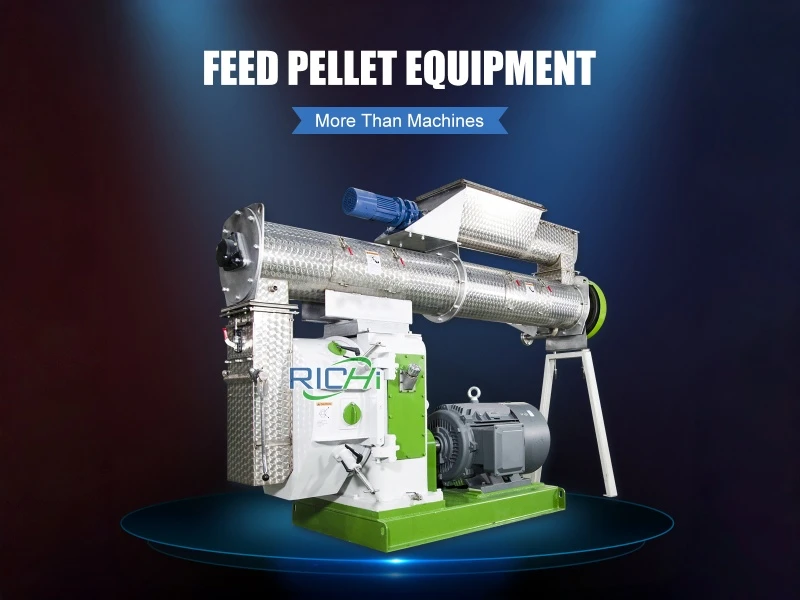
Animal feed production has evolved from simple on-farm mixing into a highly organized manufacturing process.
Today, even relatively small agricultural businesses can produce their own formulated pellets, while large feed manufacturers operate automated plants capable of processing many tons per hour.
The basic principle remains straightforward: prepare ingredients, combine them accurately, compress them into pellets, and stabilize the finished product.
The challenge lies in designing a system that matches the actual production environment.
A good animal feed granulator is therefore not simply a machine that makes pellets. It is part of a broader production strategy involving nutrition, raw materials, equipment, labor, energy, storage, and distribution.
Why Do Farmers Pelletize Feed?
Loose feed can be practical, but it also presents several challenges.
Different ingredients can separate during transportation. Fine particles can create dust. Some ingredients may be difficult for animals to consume uniformly.
Pelletizing addresses several of these issues by creating compact, relatively uniform particles.
Pellets can also simplify transportation and feeding.
For commercial feed producers, consistent pellet dimensions can help create a recognizable product.
For farms producing their own feed, pelletizing can make locally available agricultural materials easier to incorporate into formulated diets.
Small Farm Systems Are Not Miniature Industrial Plants
A common mistake is assuming that a small farm simply needs a smaller version of a large commercial feed mill.
The reality is more nuanced.
Small farms often have different priorities:
- Lower investment
- Simple operation
- Easy cleaning
- Flexible production
- Local raw materials
- Limited labor
- Low maintenance complexity
A compact pelletizing system may therefore be a better choice than a highly automated industrial line.
The equipment should make the farm’s work easier rather than create unnecessary complexity.
Commercial Feed Mills Have Different Priorities
As production increases, consistency and material flow become more important.
Commercial plants may process multiple formulas every day.
They require reliable batching, accurate weighing, efficient material transfer, stable pellet production, cooling, screening, and packaging.
Downtime becomes more expensive because every hour of lost production represents a significant volume of unfinished feed.
Therefore, commercial systems often emphasize automation and process control.
Capacity Planning for Different Animals
Animal type has a direct effect on feed demand.
A rabbit farm may require a relatively modest volume compared with a large poultry operation.
Poultry production can consume significant quantities of feed, particularly in commercial broiler systems.
Livestock operations may have different seasonal patterns.
For this reason, capacity should always be calculated according to actual feed demand.
A producer looking for a 5-6 T/H chicken feed pellet making machine for sale should calculate whether this capacity corresponds to daily production needs, operating hours, and future growth.
Buying equipment simply because the number looks impressive can lead to unnecessary capital investment.
Why Rabbit Feed Can Require Flexible Processing
Rabbit diets frequently contain fibrous materials such as alfalfa, grass meal, and hay.
These ingredients can influence pellet formation.
A high-fiber formulation may behave differently from a grain-based poultry diet.
This makes flexibility important.
A rabbit feed producer should discuss the formulation with the equipment supplier and confirm whether the proposed system can handle the intended material mix.
For a project requiring several tons per hour, a rabbit pellet maker for sale may be considered for smaller commercial operations, while larger facilities may need a different configuration.
The Importance of Ingredient Preparation
Good pellet production begins before the material reaches the pellet machine.
Raw materials may need to be cleaned and reduced to a suitable particle size.
Grinding can improve the uniformity of the feed mixture and make compression more predictable.
However, grinding requirements vary.
Corn may require a different treatment from long grass or hay.
Some ingredients may already have an appropriate particle size.
The goal is not maximum grinding. The goal is appropriate preparation for the final feed product.
Formulation Comes Before Machinery
Feed producers should define the formula before choosing the production line.
A formulation may contain:
- Energy ingredients
- Protein sources
- Fiber sources
- Minerals
- Vitamins
- Functional additives
The physical characteristics of these ingredients can affect processing.
A formulation with a high fiber level may require different processing conditions from a formula dominated by grains.
Therefore, equipment selection should follow feed formulation.
What Does Conditioning Add?
Conditioning prepares the feed mixture before pelletizing.
Depending on the process, moisture and heat can be introduced to improve material behavior.
Conditioning may influence pellet durability, throughput, and energy efficiency.
However, conditioning must be controlled.
Too much moisture can make cooling and storage more difficult. Too little may reduce pellet formation quality.
The appropriate approach depends on the formulation and equipment.
Why Cooling and Screening Complete the Process
Pelletizing does not produce a finished commercial product by itself.
Fresh pellets require cooling before storage or packaging.
Cooling helps stabilize the product.
Screening then removes fines and particles outside the desired size range.
Together, these stages improve final consistency.
For commercial production, these downstream systems should be matched to pelletizing capacity.
An undersized cooler can become a production bottleneck just as easily as an undersized grinder.
Pellet Diameter and Animal Age
Pellet diameter should be selected according to the target animal and feeding stage.
Young animals may need smaller particles.
Older animals may consume larger pellets.
Different livestock species also have different feeding preferences.
The die specification should therefore be determined after defining the final feed product.
This is especially important for manufacturers producing several feed types because different formulas may require different pellet specifications.
What Is the Role of Automation?
Automation can improve production consistency.
A centralized system can manage ingredient weighing, batching, mixing, and production monitoring.
Automation also helps reduce manual measurement errors.
However, automation is not free.
It increases initial investment and may require operators with additional technical skills.
A practical approach is to automate the processes that provide the greatest operational value.
For example, accurate automated batching can be highly valuable in a commercial plant because small formulation errors can become significant when thousands of tons are produced.
Can One Plant Produce Multiple Feed Types?
Yes, but the plant needs to be designed accordingly.
A diversified feed producer might manufacture chicken feed, rabbit feed, cattle feed, and other livestock products.
The main challenge is managing formulation changes and preventing unwanted material carryover.
The plant may need appropriate cleaning procedures, storage arrangements, and production scheduling.
A flexible production line can increase market opportunities, but flexibility should be designed into the system from the beginning.
Choosing Between Simple and Automated Systems
The right choice depends on scale.
Small Farm
A small farm may benefit from:
- Compact equipment
- Manual or semi-automatic batching
- Simple conveyors
- Limited storage
- Easy maintenance
Medium Operation
A medium-sized business may need:
- Higher-capacity grinding
- More accurate batching
- Larger mixers
- Better material handling
- Automatic or semi-automatic packing
Commercial Feed Mill
A large plant may require:
- Automated batching
- Multiple storage bins
- Continuous pelletizing
- Efficient cooling
- Screening
- Automatic packing
- Centralized control
- Product management systems
This tiered approach helps avoid both underinvestment and unnecessary investment.
What Should Be Considered Beyond Machine Price?
Purchase price is only one financial factor.
A more useful calculation considers the total cost of ownership.
This includes:
- Equipment investment
- Building modifications
- Installation
- Electricity
- Labor
- Maintenance
- Spare parts
- Product losses
- Downtime
- Packaging
A machine with a low purchase price can become expensive if it requires frequent maintenance or cannot reach the expected output.
Similarly, a sophisticated system may not be economical if the production volume is too low.
How Can Buyers Evaluate Equipment Suppliers?
Supplier evaluation should focus on practical capability.
Ask whether the supplier can provide:
- Complete process design
- Equipment selection
- Capacity calculations
- Layout drawings
- Installation guidance
- Operator training
- Spare parts
- After-sales service
- Project references
For buyers researching pelletizing equipment, pellet maker information from established manufacturers can provide a starting point for understanding machine configurations and production options.
However, online specifications should always be checked against the actual project.
Where Should Further Research Begin?
There is a large amount of information available about animal feed production.
Agricultural websites, machinery manufacturers, industry publications, technical forums, and look at this website resources can help buyers understand different equipment options.
The most useful research should answer practical questions rather than simply provide general definitions.
For example:
What capacity is actually required?
Which raw materials will be processed?
What pellet diameter is needed?
Will the plant produce one feed type or several?
How many workers are available?
What is the available electrical supply?
How much space is available?
What level of automation makes financial sense?
These questions can turn general research into a practical equipment plan.
Common Planning Mistakes
Several mistakes appear repeatedly in feed production projects.
Choosing Capacity Based on Marketing Numbers
A machine’s maximum rated output may not represent the actual output for every formulation.
Ignoring Raw Material Characteristics
High-fiber, high-moisture, or oily ingredients can behave differently during pelletizing.
Underestimating Downstream Equipment
Cooling, screening, and packing can become bottlenecks.
Focusing Only on Purchase Price
Operating and maintenance costs may be more important over the equipment’s lifetime.
Buying Too Much Automation
Sophisticated systems can be unnecessary for small operations.
Forgetting Future Growth
A plant that has no room for expansion may become restrictive as the business grows.
A More Practical Way to Plan a Feed Plant
Instead of beginning with a machine catalog, begin with the production target.
Step 1: Define the animals and feed types.
Step 2: Establish the feed formulation.
Step 3: Estimate daily and monthly demand.
Step 4: Determine pellet size and product requirements.
Step 5: Identify raw material characteristics.
Step 6: Calculate realistic hourly production.
Step 7: Design grinding and mixing capacity.
Step 8: Select the pelletizing system.
Step 9: Match cooling, screening, and packaging.
Step 10: Evaluate investment and operating costs.
This process reduces the risk of purchasing equipment that does not fit the actual application.
The Future of Feed Granulation
Feed production is likely to become increasingly data-driven.
Automation, process monitoring, energy management, and better formulation control can help manufacturers improve consistency.
At the same time, smaller farms may continue to favor flexible and affordable systems that allow them to use local resources.
The future is therefore unlikely to be defined by one universal machine.
(Related Post: https://www.richipelletmill.com/rabbit-pellet-making-machine/)
Instead, different production scales will require different levels of technology.
Conclusion
Feed granulation connects nutrition with practical farm management.
A successful system must produce the right pellet, at the right capacity, from the right raw materials, at an acceptable operating cost.
For rabbit producers, fiber-rich formulations may be a major consideration. For poultry producers, high throughput and consistent pellet quality may take priority. For diversified commercial manufacturers, flexibility and automation can become more important.
The best approach is to design the production process around the final product and the real needs of the business.
When equipment selection follows this principle, feed producers are more likely to achieve reliable production, manageable operating costs, and a system that can grow with the farm.